
Criminal Cases in the McCulloch County Courts
McCulloch County criminal cases do not sit in one office. The 452nd Judicial District Court hears felonies, and the District Clerk keeps its indictments, pleadings, orders, docket activity, judgments, sentences, and expunction filings. The criminal counter is in Room 103 at the courthouse. County Court hears Class A and B misdemeanors, but those files are kept by the County Clerk at a separate High Street office. That physical split is just as important as the legal one.
Fine-only state misdemeanors may reach the McCulloch County Justice Court, which also performs magistrate work. Brady Municipal Court keeps fine-only citations and ordinance matters filed there by Brady Police or Animal Control. A cause number is the best key when it is known. Otherwise, give the clerk a full name, an approximate filing year, and the likely offense level. A sheriff booking record does not replace any of these court files.
McCulloch Criminal Courts by Level
The alleged offense guides the search. An MA or MB entry on a published county docket means a Class A or Class B misdemeanor, not the result of the case. A felony allegation belongs at the district level. A city citation can remain wholly outside both clerk systems. When the level is unclear, ask both county clerks to check rather than assuming that an empty search means no case exists.
District Clerk
199 Courthouse Square, Room 103
Brady, TX 76825
325-597-0733 ext. 1
Monday to Thursday, 8 a.m. to 5 p.m.; Friday, 8 a.m. to 3 p.m.
County Clerk
101 N. High Street
Brady, TX 76825
325-597-2400 ext. 2
Monday to Thursday, 8 a.m. to 4:45 p.m.; Friday, 8 a.m. to 3 p.m.
How to Search Case Records
Begin at the official District Clerk or County Clerk page. Both advertise online records access, while the clerk remains the source for certified documents and images that are not public online. Published County Court dockets help locate settings, but each is only a dated snapshot.
- Decide whether the allegation is a felony, Class A or B misdemeanor, or fine-only citation.
- Enter the clerk's current online search from the official county page, then select the correct office and record type.
- Search with a cause number when possible. If using a name, confirm it against the offense, year, court, and agency.
- Open the index or image preview and review the docket events, not just the case caption.
- Ask the custodian for the docket sheet, charging instrument, judgment, sentence, and any certified copies needed.
For a Brady citation, contact Municipal Court rather than a county clerk. Its staff search covers citations filed there by Brady Police or Animal Control. If the offense level cannot be determined from a citation, booking entry, or docket code, tell each clerk what facts are known and ask which office has the cause.
McCulloch Court Records in LGS
McCulloch County clerks use the Local Government Solutions online records system. Guests can see index information and public image previews. Buying a full image requires registration and email verification, followed by the choice of office and record type. Search results use arrow controls for page navigation and offer “More Information” and “Images” views.
The portal's public interface is shown in the official LGS record-search source below. Its county and record-type choices make the right office selection a key first step.
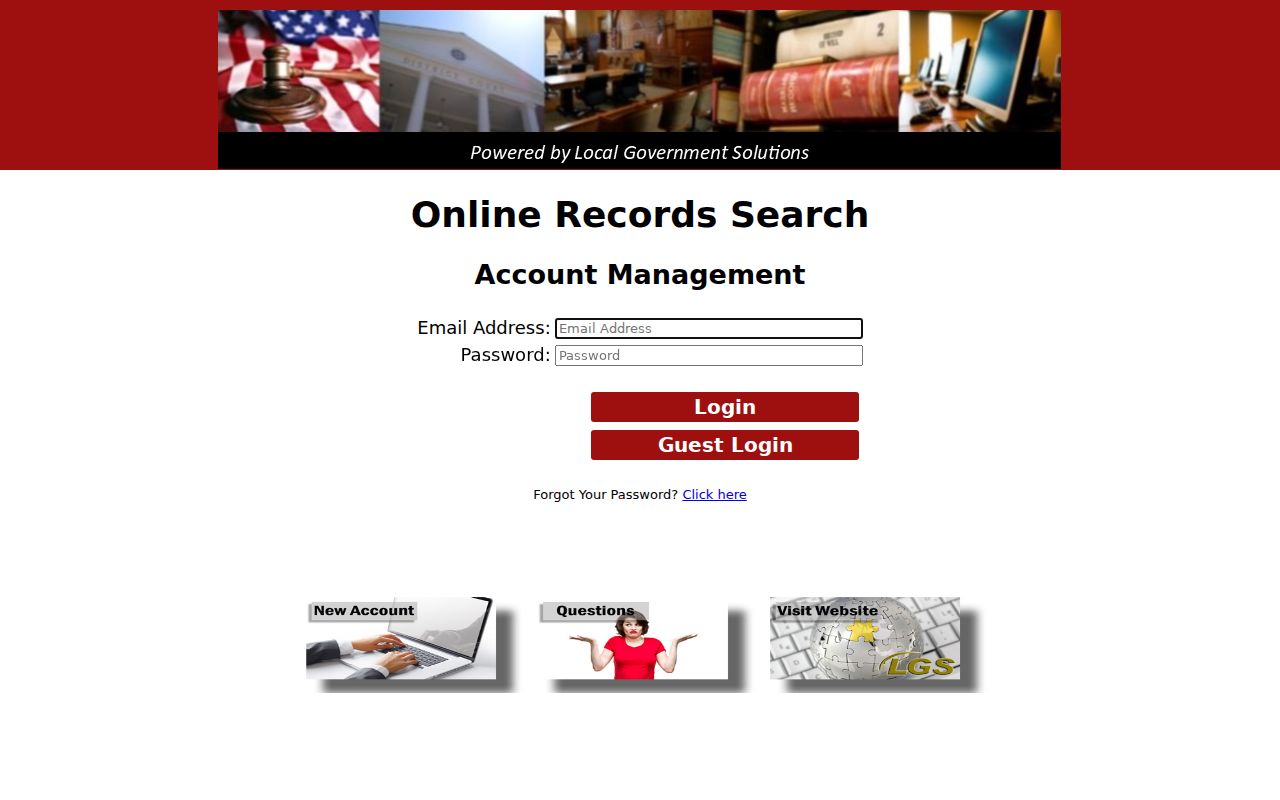
The screen is an index and purchase path, not a promise that every criminal pleading is available as a public image.
| Portal control | Use | Access note |
|---|---|---|
| Office | Select the District or County Clerk | Match the case level first |
| Record type | Choose the available court index | Dynamic choices may change |
| Search criteria | Enter a name or cause data shown | Use several facts to confirm a match |
| More Information | Review the indexed case detail | May not include the filed document |
| Images and Cart | Preview or buy public images | Registration is needed to purchase |
Checkout adds a required $0.30 transaction fee. Registered users may buy five court-case images before a subscription is required. McCulloch County image and subscription prices were not published in the reviewed vendor help material, so confirm them in the live system before purchase.
What the Case File Shows
A McCulloch County criminal case file records what the prosecutor filed and what the court did. The caption and docket lead to the papers that show the legal charge, the hearing path, and the final result. County Court docket PDFs also show useful index facts, but no one line should be read without the judgment or dismissal order that resolves it.
| Cause Number and Court | The unique local file key and the tribunal that handled the matter. |
|---|---|
| Charging Document | The complaint, information, or indictment stating the filed allegation. |
| Docket Entries | A dated index of settings, motions, orders, pleas, and other court events. |
| Hearing Dates | Arraignment, pretrial, plea, trial, sentencing, and other scheduled settings. |
| Disposition and Judgment | The recorded outcome, such as dismissal, acquittal, deferred adjudication, or conviction. |
| Sentence and Conditions | Confinement, community supervision, fines, court costs, and filed terms. |
Ask for a plain copy when the content alone is enough. Request certification when an official copy of the judgment, dismissal, or sentence is needed. The clerk can also explain whether an image is public online, available only at the counter, held in an older paper file, or subject to a court restriction.
Reading McCulloch Criminal Dockets
Published McCulloch County Court dockets can show the cause number, offense description and date, MA or MB level, bond, bond company, attorney, arresting agency, setting time, setting type, balance, and comments. Disposition sheets may add confinement, probation term, fine, costs, and reimbursement fees. These fields help a reader identify the right file and see its current posture.
A docket is not the whole file. It may omit the charging instrument, evidence, complete conditions, payment ledger, or a detailed order. “Arraignment” names a setting where the accusation is presented and a plea is entered or scheduled. “Disposition” means the recorded outcome. “Deferred adjudication” is supervision after a plea without an immediate final judgment of guilt, though it can still appear in the Texas DPS public product unless lawfully restricted.
Note: MA and MB identify misdemeanor levels; neither code says whether McCulloch County dismissed, deferred, or convicted the charge.
Stages of a Criminal Case
After an arrest and booking, a magistrate gives warnings, addresses probable cause, considers bond, and handles counsel when the law requires it. A prosecutor then screens the referral. A misdemeanor may proceed by complaint and information. A felony ordinarily goes through a grand jury and indictment before the 452nd Judicial District Court moves to arraignment.
Discovery, motions, plea talks, and settings follow. The case can end through dismissal, acquittal, a guilty plea, conviction after trial, or deferred adjudication. A judgment and sentence supply the court disposition later reported to Texas DPS. An appeal from McCulloch County proceeds through the proper appellate route, with the county served by the Third Court of Appeals.
Case flow: Charges Filed › Arraignment › Pretrial › Plea or Trial › Disposition › Sentencing
Why McCulloch Cases Stay Local
re:SearchTX is Texas's statewide document-access system, but it is not a sound substitute for McCulloch County criminal clerks. The Texas Judicial Council reported that the public re:SearchTX corpus excludes criminal case records. An empty statewide result therefore does not establish that no local case exists.
The correct fallback is the District Clerk for felonies, County Clerk for Class A and B misdemeanors, and the proper municipal or justice clerk for fine-only matters. For a broader view of county record types, the McCulloch County criminal history overview explains how court, booking, and DPS records differ.
The Northern District of Texas is a separate federal system. The official Northern District court source shows that McCulloch County is assigned to the San Angelo Division.
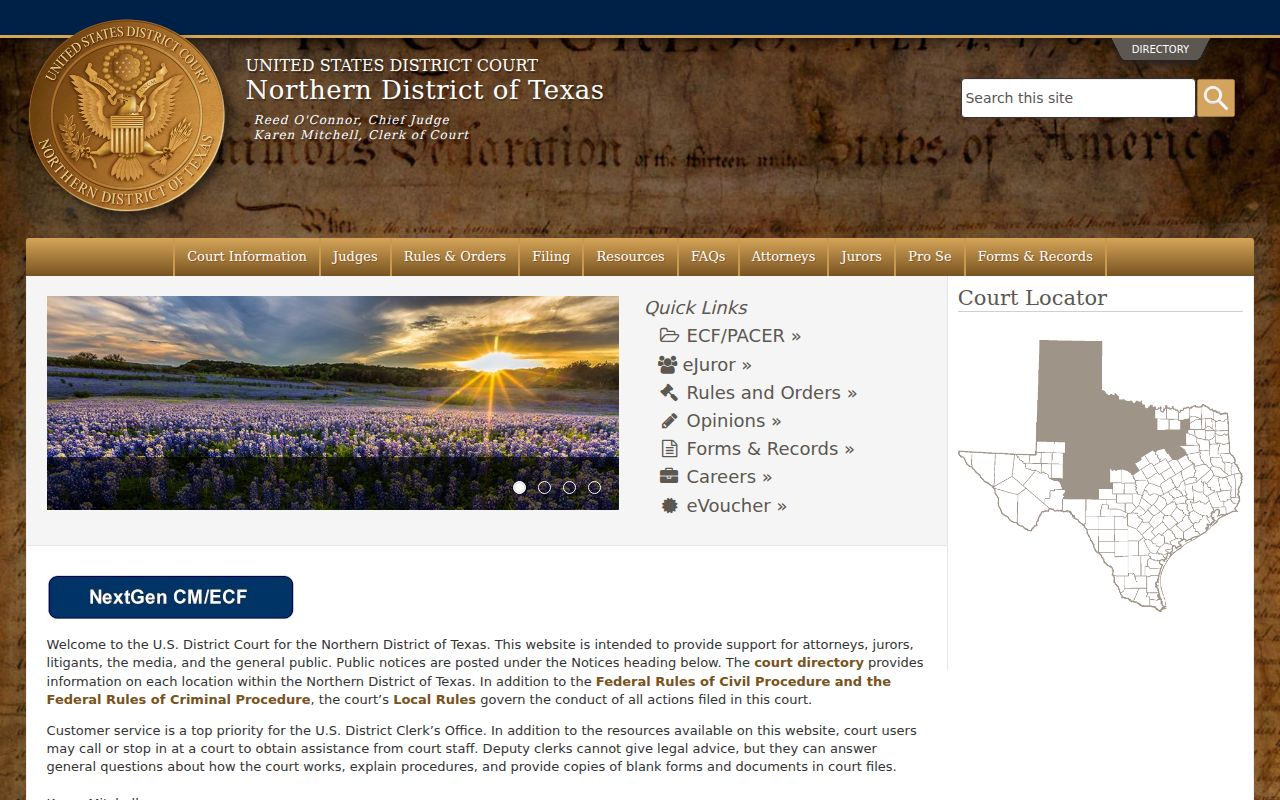
Federal cases are searched through PACER and the federal clerk, not through either McCulloch County clerk.
Access & Restrictions
Public access depends on the custodian and the record. Clerk-held judicial files are requested under the court-record access framework, while executive agency records fall under the Texas Public Information Act. A clerk may provide an index online while requiring a counter, mail, or copy request for the filed paper. Older courthouse files may be on paper or in an archive, so call with the name, year, court, and cause number before travel.
Juvenile material, sealed filings, protected victim facts, Social Security and driver's-license numbers, medical data, and records affected by expunction or nondisclosure can be withheld or redacted. If a result is absent, ask whether the case is archived, indexed under another name, restricted, or held by a different clerk. Do not treat absence from LGS or re:SearchTX as a final answer.
Certified McCulloch Case Outcomes
A certified judgment or dismissal from the right clerk is stronger evidence of a McCulloch County case outcome than a roster entry, a docket snapshot, or a name-based repository result. County Clerk general pricing is $1 per page or part of a page and $5 for certification, though the clerk should confirm that rate for the requested criminal instrument. The District Clerk should quote its own copy and certification cost.
Brady Municipal Court handles its record searches by request. The search reaches only citations filed there by Brady Police or Animal Control, may take up to ten days, and provides the first two pages free before charging $0.10 per added page. Mail goes to Municipal Court Record Searches, P.O. Box 351, Brady, TX 76825.
If the certified court outcome differs from a Texas DPS record, send that proof through the DPS Error Resolution process. That step corrects a reporting error; it does not itself erase a valid arrest cycle.